
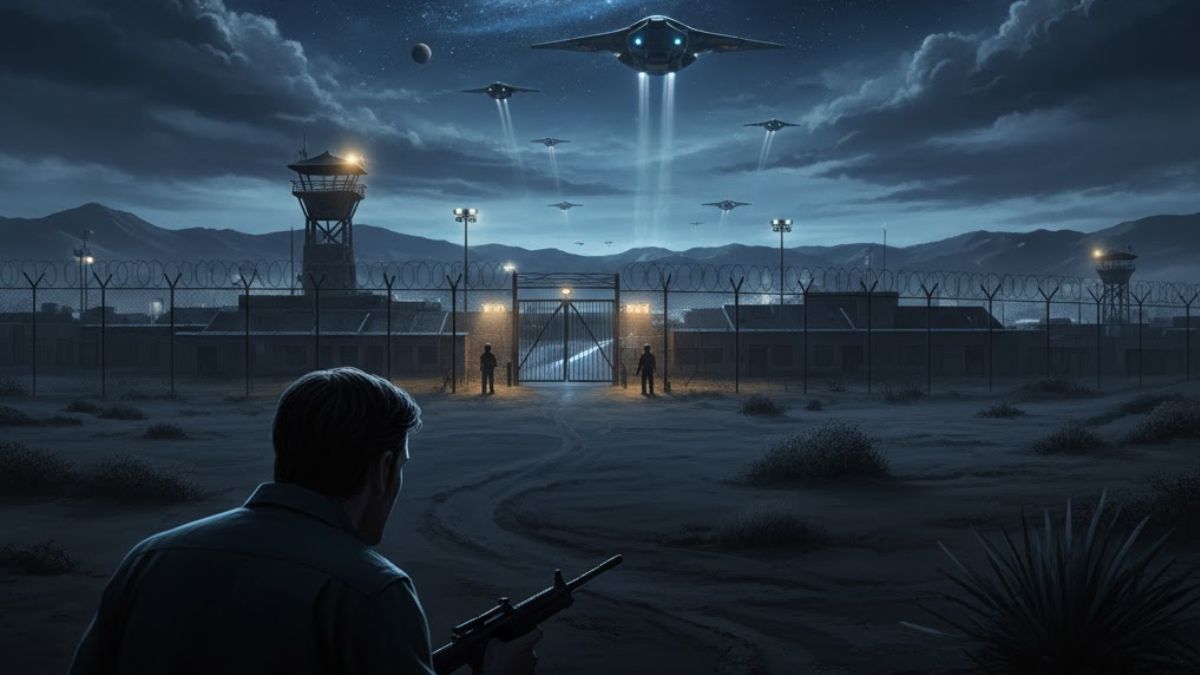
There’s a stretch of highway in Nevada known as the “Extraterrestrial Highway.” It’s a long, lonely road, with dust and tumbleweeds for company. And if you drive far enough, you’ll see the signs. They’re simple, stark, and carry a heavy message: warning against photography, forbidding entry, and promising severe penalties for trespassers. This is the perimeter of Area 51.
For decades, this place hasn’t just been a military base; it’s become a giant question mark on the map of the world. It lives in our movies, our books, and our late-night conversations. We whisper about captured alien spacecraft, secret technologies, and meetings with beings not from this world. But the most compelling stories aren’t about the aliens or the UFOs—they’re about the people who worked there. The scientists, engineers, and staff who walked through those gates every day.
What happens to them when their work is done? They don’t write memoirs or go on talk shows. They fade back into their quiet lives, carrying secrets they can never share. This silence isn’t just about professionalism; it’s a deep-seated culture of fear and obligation that lasts a lifetime. So, what is it about this place that seals lips so completely, turning ordinary employees into vaults of classified information?
What would it truly cost someone to tell the world what they’ve seen?
What is Area 51, Really?
To understand the silence, we first have to understand what we’re dealing with. Officially, Area 51 is a remote detachment of Edwards Air Force Base. Its primary, acknowledged purpose is to serve as a testing and development facility for aircraft. This is where some of America’s most famous spy planes, like the U-2 and the SR-71 Blackbird, were born and tested. Imagine a giant, secret workshop in the middle of nowhere, where the world’s most advanced airplanes are built and flown.
Because these aircraft looked so strange and could fly at incredible heights and speeds, it’s no wonder people saw them in the sky and thought, “That can’t be from this world.” A secret, futuristic plane is easily mistaken for a flying saucer. So, while the government was testing new ways to watch its enemies from the sky, the public was looking up and dreaming of aliens. This is the core of the mystery: a real, secret military mission accidentally created a perfect legend.
But the secrecy around the base went beyond just keeping new planes hidden. The government refused to even admit the base existed for a very long time. If a place doesn’t officially exist, then the people who work there are ghosts, and the projects they work on are shadows. This level of denial only made the outside world more curious. If it was just about airplanes, why the absolute, total blackout on information?
The Lifelong Oath: More Than Just a Signature
When you are offered a job at a place like Area 51, your first day isn’t about filling out tax forms and getting a tour of the breakroom. It begins with a stack of documents and a solemn promise. Signing a security clearance is not like signing a typical job contract. It is a lifelong pledge of silence, backed by the full force of the law.
Think of it as making a promise to your country that you will never, ever talk about your work. Not with your spouse over dinner. Not with your best friend from college. Not even with a fellow employee unless you are directly working together on the same project. This oath doesn’t have an expiration date. It doesn’t end when you retire or change careers. It binds you until the day you die.
The weight of this promise is immense. You are being trusted with information that is considered vital to national security. Breaking that trust isn’t just a firing offense; it’s a federal crime. This creates a powerful mental prison. Employees live with the constant knowledge that a single slip of the tongue, a single shared photo, could lead not just to job loss, but to prosecution, massive fines, and prison time. Your entire life and livelihood are on the line. Would you risk everything for a story?
A Culture of “Need to Know” and Constant Watchfulness
Inside the fence, a specific culture takes root, built on a simple, powerful principle: “need to know.” You are only told what you absolutely need to complete your specific task. The janitor who cleans a hallway doesn’t know what’s behind the door. The engineer working on a landing gear system might not know the full capabilities of the aircraft’s radar.
This system is designed to compartmentalize information. It means that even if someone wanted to reveal a major secret, they likely only possess a small piece of the puzzle. It’s like working on a giant jigsaw puzzle while being locked in a room with only one piece. You have no idea what the final picture looks like.
This is paired with an environment of constant, subtle surveillance. While it might not be as dramatic as men in black suits following your every move, there is an understanding that you are being watched. Communications are monitored. Movements on the base are tracked. There is an unspoken pressure to conform, to be a team player, and to never, ever ask too many questions. This atmosphere of watchfulness becomes normal, a part of daily life that reminds you that your loyalty is always being assessed.
The Real Consequences of Breaking Silence
We’ve all heard the wild stories of people who claim to have broken the silence. But what happens in reality? The legal consequences are severe and clear-cut. Leaking classified information is a violation of the Espionage Act, a law from 1917 that carries incredibly heavy penalties. We’re talking about decades in a federal prison.
But the punishment isn’t just legal. There is a powerful social and professional cost. The community of people who work in these secretive fields is tight-knit. If you break your oath, you are not just a criminal in the eyes of the government; you are a traitor in the eyes of your former colleagues. You would be blacklisted from ever working in the aerospace or defense industry again. Your reputation would be destroyed, permanently.
Then there is the personal toll. Imagine the suspicion you would face from your own family and friends. They would wonder what else you had lied about all those years. The trust you built over a lifetime could crumble in an instant. The fear of these consequences—losing your freedom, your career, and the respect of everyone you know—is a far more effective silencer than any mythical “memory wipe” technology.
Is the Fear Just About Breaking the Law?
While the threat of prison is a powerful deterrent, many believe the fear goes deeper. It’s about what you are protecting. Many employees are patriots; they believe their work is crucial for keeping the country safe. Revealing secrets, even ones they think are harmless, could potentially give an adversary a piece of a puzzle they shouldn’t have. The guilt of potentially endangering national security can be a heavy burden to carry, and for some, it’s a key reason for their silence.
There’s also the fear of ridicule. Let’s say an employee did see something they couldn’t explain—something truly bizarre. If they were to speak about it, they would be instantly thrown into the world of UFO conventions and sensationalist media. Their credibility, their life’s work, would be dismissed as the ramblings of a conspiracy theorist. For a respected scientist or engineer, that loss of professional dignity is a terrifying prospect. It’s often easier to stay quiet than to be labeled a “UFO nut.”
Could the Truth Ever Be Told Safely?
This is the great dilemma. Is there a way for the truth to come out? The government does have a process for declassifying information, but it is slow, often taking 25 years or more. And even then, the most sensitive information, the real “crown jewels” of secret projects, may never see the light of day.
Some hope that a future president or a act of Congress could mandate a “great disclosure,” forcing all the secrets of Area 51 into the open. But the logistics of that are a nightmare. How do you verify what is true? How do you separate decades of wild speculation from the actual, mundane, yet still highly secret, military projects? And what about the potential geopolitical fallout of revealing technologies and methods that are still in use?
For the individual employee, the calculation is simple and stark. The system is designed to make silence the only safe path. The personal risks of speaking out are guaranteed and devastating, while the benefits are uncertain at best. The secret of Area 51 is kept not by futuristic gadgets, but by the very human, very understandable fears of the people who work there.
Conclusion
The mystery of Area 51 is a story built on two layers. On one layer, there is the public legend of alien spacecraft and otherworldly secrets. On a deeper, more human layer, there is the story of the people who signed a promise and have chosen, every single day since, to keep it. Their silence is enforced by a combination of law, loyalty, fear, and the potential for personal ruin.
The base itself may just be a top-secret military workshop, but the culture of absolute secrecy surrounding it is very real. It’s a culture that turns employees into guardians of a vault, not because they are threatened with some sci-fi weapon, but because they are bound by a promise that carries the weight of their entire life. The most powerful secret kept at Area 51 might not be about what lies in a hangar, but about the profound power of a promise that can never be broken.
If you knew a secret that could change the world, but telling it would destroy your own life, what would you choose?
FAQs – People Also Ask
1. Can you legally visit Area 51?
No, you cannot visit Area 51. It is an active, top-secret military installation. The land is federally protected, and the perimeter is marked with warning signs. Trespassing is illegal and can result in arrest and federal prosecution.
2. Has the government ever admitted Area 51 exists?
Yes, but only relatively recently. The U.S. government officially acknowledged the existence of Area 51 in 2013 when declassified CIA documents related to the U-2 spy plane program were released, which mentioned the base by name.
3. What is the difference between Area 51 and S-4?
Area 51 is the main operating base, which includes runways, hangars, and support buildings. S-4, or “Site 4,” is a specific, alleged facility located near Area 51. It was famously mentioned by whistleblower Bob Lazar, who claimed it housed alien spacecraft. Its existence has never been officially confirmed.
4. What kind of airplanes were tested at Area 51?
Some of the most famous aircraft tested there include the U-2 and SR-71 Blackbird spy planes, and the F-117 Nighthawk stealth fighter. These planes were developed in secret, and their strange shapes led to many UFO sightings.
5. Why is it called Area 51?
The name comes from its designation on old Nevada Test Site maps. The area was divided into numbered sectors for atomic testing in the 1950s, and this particular parcel was numbered 51.
6. Are there any real photos of the inside of Area 51?
There are no legally taken, publicly available photos of the inside of the base’s sensitive areas. Any photos that exist are either old, declassified images from a distance, satellite photos which show buildings from above, or illegal and blurry pictures taken by trespassers.
7. What happens if you try to sneak into Area 51?
You will be caught. The base is protected by armed guards, motion sensors, and aerial surveillance. Trespassers are apprehended, detained, and face federal charges, which can lead to hefty fines and jail time.
8. Did the “Storm Area 51” event actually happen?
The “Storm Area 51” event was an internet meme that went viral in 2019. While a massive crowd did gather in the nearby town of Rachel, Nevada, for a music festival, no one actually attempted to storm the base. The event was largely a peaceful, if eccentric, gathering.
9. Who works at Area 51?
The workforce consists of military personnel, civilian contractors, and scientists and engineers from private defense companies like Lockheed Martin. Employees are rigorously vetted and must hold extremely high-level security clearances.
10. What is the most believable explanation for Area 51?
The most credible explanation, supported by declassified documents, is that Area 51 is a highly classified research, development, and testing facility for advanced military aircraft and weapons systems. The secrecy is to maintain a technological advantage over other nations, not to hide extraterrestrial life.